
What should be in a textile that touches the human body for thousands of hours?
–Katya Moorman

One of the things I’ve learned through my sustainability journey is that, for all their marketing, most large corporations do not necessarily have our best interests at heart. How else do we explain years of putting chemical flame retardants on children’s pajamas or artificial red dye in M&M’s?
And while I’ve shared my thoughts on synthetic clothing here, here, and here—TL;DR: not a fan—it was only recently that I became aware that applying chemical dyes and finishes to natural fibers may not be much better.
Fortunately, there are already people addressing this.
In my second article on Brands People Doing Things Differently, I want to introduce you to AIZOME Textiles. I recently spoke with cofounder Michel May about how the company is doing things differently—and better—for people and the planet.
Michel describes AIZOME as a textile health company rather than simply a bedding or apparel brand. That’s the sort of phrase that brings out my inner skeptic, but he explained that it changes the question the company starts with.
“We do not ask, ‘How do we make a nicer bedsheet or shirt?’ We ask, ‘What should be in a textile that touches the human body for thousands of hours?’”
That question first came to him when his mother was being treated for cancer.
“My mother developed dark sores on her skin during cancer treatment. Her oncologist suggested that the dyes in her bedding might be contributing to the irritation. I was skeptical, but we changed the bedding, and the sores disappeared,” he explained, while adding that this was not a scientific experiment or proof of causation.
Still, it sent him down the rabbit hole of color and chemistry in textiles.
What Is Actually in a Bedsheet?
Is there anything more basic than a bedsheet? It’s a large piece of fabric made from cotton, linen, polyester, or some combination of fibers. The label tells us what it contains and where it was made. If it’s cotton, it may tell us the thread count.
What else is there to know? Quite a lot, apparently.
A sheet may be labeled 100 percent organic cotton while telling us almost nothing about what was used to bleach, dye, soften, or finish it.
Packaged food has a nutrition label. Cosmetics have ingredient lists. The absence of anything comparable for textiles gets discussed in sustainable fashion circles, but I don’t think it’s something most people consider while shopping for sheets.
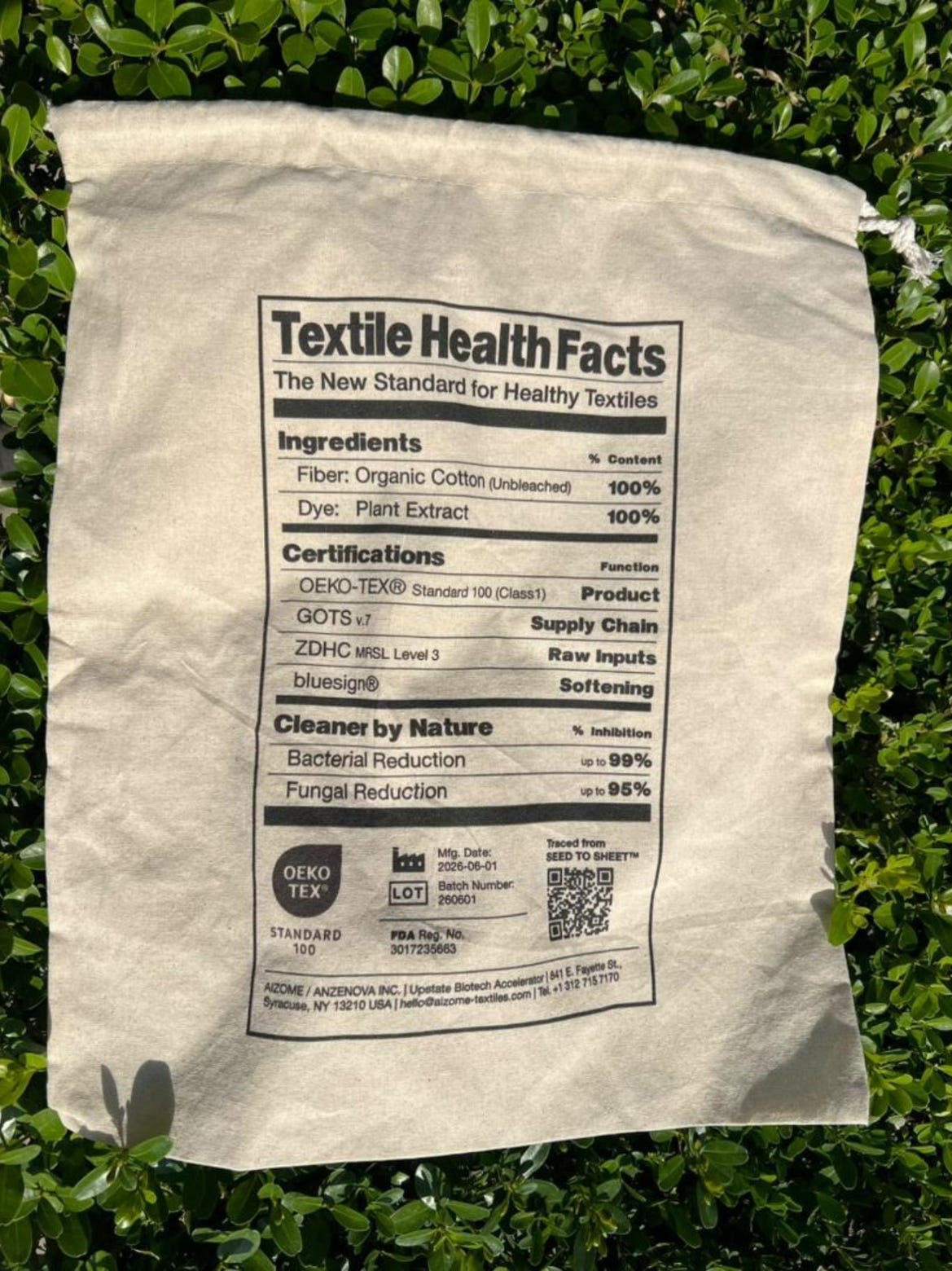
AIZOME created what it calls a Textile Health Facts label to change this. The label is inspired by that familiar Nutrition Facts panel used on food packaging. And you may have seen a version online by Peter Gorse. AIZOME worked with Peter on perfecting their label. It goes beyond fiber content to include the coloration method, important processing and finishing inputs, substances deliberately excluded, relevant testing, manufacturing origin, and traceability.
Its products also carry manufacturing dates and batch numbers connected to information about the cotton, dyeing records, and construction. This is normal in food and medicine, where a manufacturer may need to trace a problem back to a particular batch. It is considerably less normal for a pillowcase.
“Our ambition is not to keep this proprietary forever,” Michel told me. “The real success would be other textile companies adopting the same level of transparency.”
Organic Cotton Is Not the Whole Story
It might surprise you that buying organic cotton doesn’t guarantee chemical purity. Organic describes how the cotton was grown, but not what happens to it next.
We don’t think about this very often, but our clothing is highly chemically engineered. Products go through a crazy amount of processing before they arrive at our doorstep.
They can be bleached, dyed with synthetic colorants and treated with optical brighteners, fragrances, formaldehyde wrinkle treatments or PFAS.
So while buying organic cotton is not meaningless, it doesn’t tell us the complete story of the finished textile.
AIZOME starts with organic, unbleached cotton and tries to keep everything that follows as simple as possible. It uses plant dyes instead of conventional synthetic dyes wherever coloration is required and avoids finishing treatments, along with synthetic antimicrobial coatings, PFAS, formaldehyde wrinkle treatments and optical brighteners. Just learning about what they don’t do made me realize how much is normally done to textiles without our knowledge.
Michel is careful not to suggest that anything natural is automatically safe or anything synthetic is automatically dangerous. The real difference is that AIZOME wants to know exactly what has gone into the textile and why it is there.
Considering how many hours our sheets and clothes spend pressed against our bodies, that does not feel like an unreasonable standard.
How Do You Dye Cotton With Plants?
When I think of natural dyeing, I imagine something fairly low-tech, done next to the plants in the garden—as seen regularly in my Instagram feed.
AIZOME’s process is closer to a laboratory than a garden.
The company uses sonochemistry, applying ultrasonic sound waves to help plant compounds penetrate cotton fibers. Because botanical color is difficult to achieve evenly and make last, this allows AIZOME to avoid many of the synthetic fixatives and other chemicals typically used to produce depth and consistency.
In simpler terms, sound energy does some of the work that additional chemistry usually would.
AIZOME creates blues with indigo, pink and rose tones with madder root, and greys with gallnut. (It also offers undyed cotton.) The result is sheets, duvet covers, towels and clothing designed to be washed, worn and lived with like anything else

Products People Actually Want to Use
For all the innovation involved, the most important part of the equation is still people.
“Bedding was the natural starting point because we spend roughly a third of our lives in bed. But our community kept asking the obvious next question: why can’t I have the same philosophy against my skin during the day?”
That led AIZOME to expand into clothing, which it calls Healthwear.
“Health may be why someone discovers it,” Michel told me. “Comfort is why they keep wearing it.”
This seems obvious, but it’s something responsible brands occasionally forget. A T-shirt can have a flawless origin story, but if it is heavy, stiff or scratchy, it will spend its life in a drawer. Sheets can avoid every unwanted treatment imaginable, but they still need to be something you look forward to getting into at night.
But What Does “Textile Health” Actually Mean?
If all AIZOME did was combine organic cotton with plant dyes, it would be great but not especially unique.
AIZOME has gone further by conducting or commissioning testing related to chemical residues, skin irritation, and antimicrobial and antifungal performance. Their bedding, towels and Healthwear are manufactured within the company’s FDA Class I medical-device establishment registration and device listing framework.
But this is an area where the wording matters, so I want to quote Michel directly:
“We conduct and commission testing on specific properties of our textiles and plant dyes, including antimicrobial and antifungal performance. Those results tell us what was demonstrated under the conditions of a particular test. They do not automatically prove that a textile will prevent, treat or cure a disease in a person.
“Likewise, FDA establishment registration and device listing are not the same as FDA approval, clearance, certification or endorsement. They do not mean that FDA independently tested AIZOME or validated every health claim we make.
“For us, the value of operating within a Class I medical-device framework is the discipline it creates around documentation, traceability, manufacturing and claims. Where we have data, we should say exactly what was tested. Where evidence is still emerging, we should say so. And where something has not been demonstrated, we should not imply that it has.”
I find this more convincing than the usual wellness-brand approach of taking one promising fact and stretching it until the product practically claims to change your life.
Instead, AIZOME is helping define what “better” textiles might actually mean.
What If This Became the Standard?
What interests me most about AIZOME is this idea that we have the right to know far more about anything designed to remain against our skin for hours at a time – and know that it isn’t harmful.
The company is showing that bedding and clothing can be made with fewer unnecessary inputs, greater traceability and more honest claims—without forgetting that the products still need to be beautiful, comfortable and practical.
The real measure of AIZOME’s success may not be how many people buy one of its sheet sets. It may be whether more textile companies are eventually forced to answer the same question: What, exactly, are you putting against our bodies?
Related Articles
- Alden Wicker’s “To Dye For” Is Your Next “Must Read”
- Wear Plastic: Eliza Corderman’s Satire of Synthetic Activewear
- There’s WHAT in My Underwear?
- It’s Time to End Our Toxic Love Affair with Synthetic Clothing
- Meet Rosie Broadhead, the Futuristic Designer Making Clothes with Skin-Nurturing Probiotics
- Indonesian Batik: Local Wisdom Comes to Fashion


